

Finding a place / Accommodation

Three ways to rent.
Two skip the deposit.

And the key money, the agency fee, the guarantor and the two-year contract. Two of the three ways into a Tokyo home skip nearly all of it. The third is the one everybody assumes is the only option. Five things to settle before you open a listing.

13 min read ·

01

Work out which route is yours

Three questions decide which of the three routes is actually open to you. Answer them before you open a single listing, because chasing the wrong one costs months.

Two paths weighed against each other: a share house on one side, an apartment block on the other

01.1Three questions

Answer these before you look at anything

Are you staying at least two years? Do you have a full-time job? Do you have regular, documented income? If any answer is no, a standard lease is probably not your route. Japanese apartments come with a two-year contract, and landlords treat proof of steady income as non-negotiable rather than as one factor among many. That is not a rejection. It is a different door, and there are two good ones.
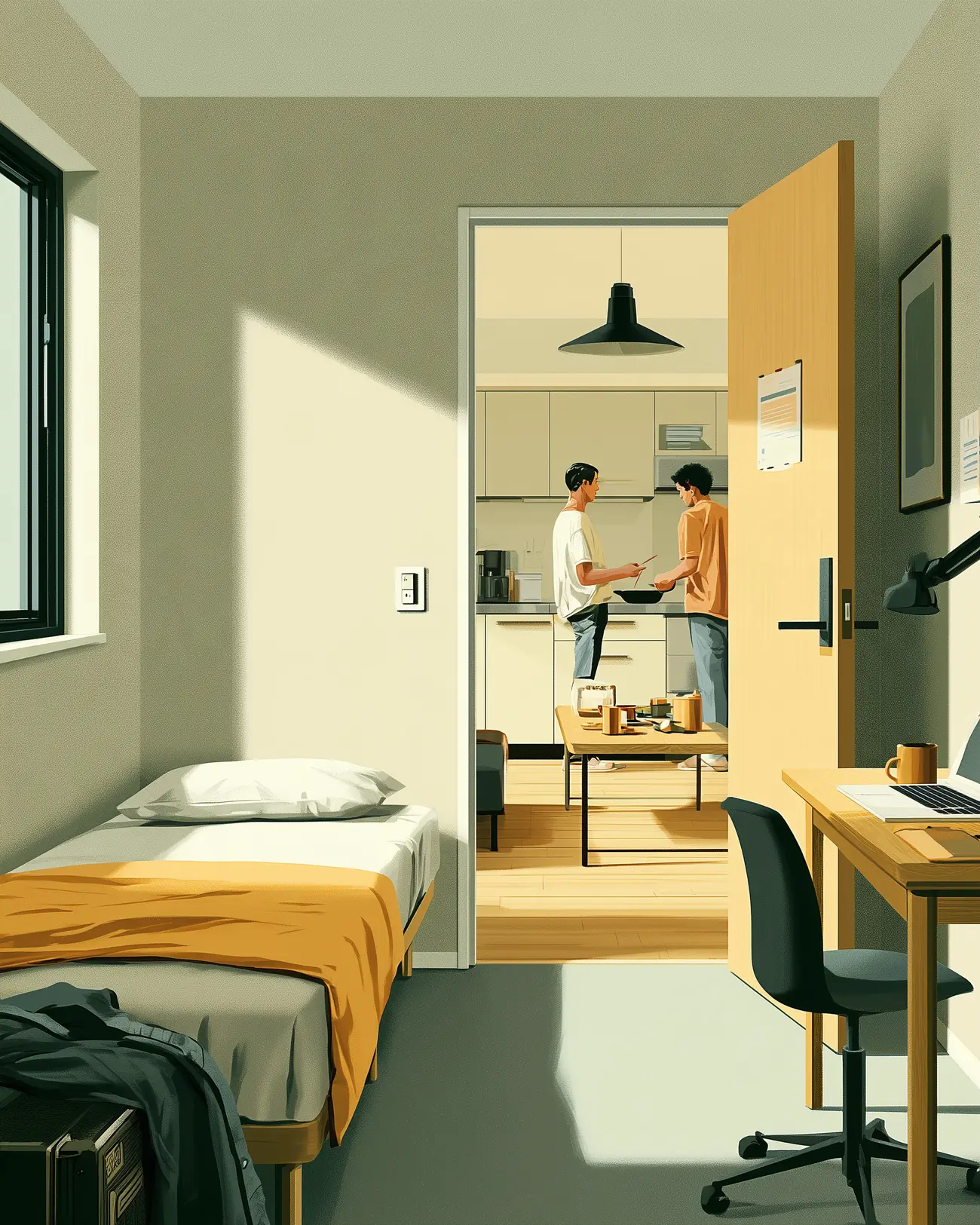
A private room in a Tokyo share house, with a shared kitchen and lounge visible beyond the door

01.2Share houses

Start with shared living

A private room, with the kitchen, bathroom and lounge shared. No guarantor, no key money and no two-year contract, which is the entire reason they exist. Most come furnished, with utilities included, on a rolling agreement. Many operators tune a house to a profile, whether that is professionals, women only, or language exchange, so you land among people in roughly your situation. It is the fastest way in and the easiest to leave.

Six operators

Where to look for a room

They differ more than the listings suggest. One aggregates everyone else, one is built for language exchange, one competes purely on price. Pick the one whose reason for existing matches yours.

Options

Tokyo Share House

Aggregates houses from many operators and lets you filter by lifestyle or interest. The clearest way to see what exists across the city before committing to anyone.

¥25,000–80,000 / month

Website
Landing

Sakura House

A long-established, foreigner-friendly operator with English support, simple rooms, private apartments and flexible contracts. The safe first landing.

¥37,000–90,000 / month, apartments from ¥90,000

Website
Balance

OakHouse

Classic share houses alongside larger social residences with coworking space and shared amenities. A middle ground between comfort and community.

¥30,000–90,000 / month, apartments from ¥80,000

Website
Community

Borderless House

Built around international living and language exchange, with a deliberately mixed roster of Japanese and non-Japanese residents. Strongly social by design.

¥40,000–60,000 / month

Website
Budget

XROSS House

No-frills houses with the lowest rent and minimal upfront cost. Rooms are basic, contracts are flexible and accessible. GG House sits in the same bracket.

¥30,000–50,000 / month

Website
Premium

Social Apartment

A premium take on shared living: large private rooms, well-designed common areas and an active resident community.

¥80,000–120,000 / month

Website
A furnished Tokyo apartment ready to live in, suitcase still by the door

01.3Serviced apartments

Ready the day you land

Fully furnished and rented by the month. Built for professionals on short or medium stays, and the best bridge while you hunt for a lease. Contracts are flexible, utilities are usually included and everything works from day one. You pay more per month than a share house and considerably more than a lease, and in exchange you skip the deposit, the key money, the guarantor and the wait.

Coverage

Fontana Tokyo City Apartments

One of the largest serviced apartment networks in the city, with hundreds of properties across the central wards. Private apartments and individual rooms in guesthouses.

from ¥60,000 / month for rooms, ¥65,000 for apartments

Website
Premium

Oakwood

Upscale serviced residences in the major business districts. Spacious, well managed, and suited to solo professionals and families alike, with hotel-level service included.

from ¥200,000 / month

Website
Curated

Tokyo Furnished

A small selection of furnished apartments in central, high-demand neighbourhoods. Boutique in approach, chosen for location and design rather than volume.

from ¥200,000 / month

Website
Hotel style

Citadines

Part of the Ascott group, offering serviced apartments with hotel services in central locations. Often overlooked, and a good option for a short stay or a first arrival.

¥180,000–250,000 / month

Website
02

Scan the market yourself

Doing your own search is not busywork. It is how you learn what your budget actually buys, so that when a good listing appears you recognise it in seconds instead of days.

Someone comparing Tokyo rental listings on a laptop, a railway map open alongside

02.1Do your own search

Know what exists before anyone shows you anything

Start on the major listing sites and build a picture of what your budget reaches, in the neighbourhoods that fit your life. The more you know about prices, layouts and commute times, the faster you will recognise the right place and the less likely you are to take the first thing offered. Some overlap between the sites is normal, but each one carries listings the others do not.

Where to look

Eight platforms, in the order that matters

Most Tokyo listings are published on a handful of Japanese platforms used by owners and agencies alike. Check the first three properly. The rest are for filling gaps.

Primary

Suumo

Japan's largest rental listing platform and the most comprehensive database in Tokyo. Filter by station, price, size and building age.

Website
Primary

At Home

Backed by the major real estate companies, with strong coverage of agency listings and properties that surface here first.

Website
Primary

LIFULL HOME'S

Aggregates listings from across the market, which makes it the best of the three for comparing neighbourhoods side by side.

Website
Secondary

CHINTAI

Skews to budget and student housing, and carries shorter lease terms that the bigger platforms tend not to show.

Website
Secondary

MiniMini

A nationwide agency with its own inventory. Particularly strong on small, affordable apartments close to stations.

Website
Secondary

Able

Another large agency with in-house listings that do not always reach Suumo. Good for standard rentals and quick availability.

Website
English only

RealEstate.co.jp

English listings and simplified communication. Inventory is thinner and prices run higher, but the process is far easier if language is the obstacle.

Website
English only

GaijinPot Housing

Aimed at non-Japanese residents, so listings here generally accept foreign applicants. A small selection, but a practical entry point on arrival.

Website

The method

How to search a Japanese rental site efficiently

Suumo, At Home and LIFULL all work the same way. Four steps, in this order, and the search stops being a scroll and starts being a shortlist.

  1. 01

    Install a translation extension

    All the major platforms are in Japanese, so set this up before anything else. A browser translation extension is enough to search, read listings and spot red flags. You do not need fluency, only the ability to scan fast and compare.

  2. 02

    Search by railway line, not by area

    In Tokyo, station access matters more than the district name. Pick the JR or subway lines you will really use, then narrow to stations. Avoiding transfers makes the commute shorter and the fare cheaper, and it widens the pool of liveable options considerably.

  3. 03

    Set the five filters that count

    Total rent including management fees, minimum size, layout, walking distance to the station, and building age. Those five remove most of what was never realistic and save you hours of scrolling.

  4. 04

    Decide where you will flex

    Keep rent under 30 percent of your income, aim for a ten minute walk or less, and prioritise buildings put up after 1981 for the modern earthquake standard. Then choose the one or two you would give up, before the listings start tempting you.

03

Talk to a professional

No matter how prepared you are, you will hit a wall without local help. Between the language, the screening and the way the market operates, turning a listing into an application is hard to do alone.

A tenant and a Tokyo estate agent going through listings together at a desk

03.1Work with an agent

They do not choose the apartment, they unlock it

Do the searching yourself first, on Suumo, At Home and LIFULL, then take your shortlist to an agent and ask them to arrange the viewings. You bring the listings, they open the doors. They will propose places of their own as well, and handle the talking with landlords and management companies, but the shortlist should start as yours. Arrive with your own finds and you decide what you see, instead of being walked through whatever happens to be convenient.

Leverage

Where your research pays off

If you have already scanned the market you will know instantly which listings are worth visiting and which to skip. Share your own finds with your agent too: they can check availability, confirm conditions and move quickly.

Timing

Speed and flexibility win

Good apartments disappear within days, sometimes hours. Being flexible on one or two criteria, the layout, the floor, the exact station, raises your chances sharply. The best outcomes come from spotting a listing early and having an agent ready to act the same day.

Reality

Do not take refusals personally

Japan has no anti-discrimination law covering rental applications. You may hear no foreigners, and equally no pets, no children, or no men. It is frustrating and it is normal. Stay consistent, keep monitoring, move on quickly. Persistence beats perfection.

04

Negotiate the move-in costs

Beyond the monthly rent, the initial fees add up fast. Some are fixed and some are genuinely negotiable, and knowing which is which is worth several hundred thousand yen.

A set of apartment keys on a table beside a stack of contracts and a calculator

04.1What it costs to get in

Budget three to six months of rent, then negotiate

The gap between three and six months is mostly down to how well you negotiate and when you sign. Everything is easier to negotiate before you apply, never after. The off season, roughly summer and late winter, gives you more room, and so do new buildings and units that have sat empty for a while, because an empty month costs the landlord more than a discount does.

Common move-in costs

The eight line items you will see

The label on each card says how much room you have. Three are effectively fixed. The rest are worth a conversation, and key money is where the largest single saving usually sits.

Deposit

敷金 shikikin

One to two months' rent

Held against damage and unpaid rent, and the only one you get back, in part, when you leave. Occasionally reducible on a newer building or a unit that has sat vacant.

Sometimes negotiable

Key money

礼金 reikin

About one month's rent

A gift to the landlord for nothing in return, and never refunded. It is also the most negotiable line here: increasingly waived outright, especially outside peak season or on a flat that has sat empty.

The one to push on

Agency fee

仲介手数料 chūkai tesūryō

Half to one month's rent

The agent's commission. Often negotiable, and most so when the same agent represents both you and the landlord.

Often negotiable

Management fee

管理費 kanrihi

Monthly, on top of rent

Pays for upkeep of the building and its common areas. It is not part of the advertised rent, so add it before you compare two listings.

Not negotiable

Guarantor company fee

保証料 hoshōryō

30 to 100% of a month

The fee for the company that stands in for a private guarantor. Most landlords now require one either way, with a smaller charge on renewal.

Not negotiable

Fire insurance

火災保険 kasai hoken

¥15,000 to ¥25,000

Compulsory, and quoted for two years. You can sometimes bring your own policy rather than take the one the agency offers.

Provider is negotiable

Key exchange

鍵交換 kagi kōkan

¥15,000 to ¥30,000

A new lock for the new tenant. Frequently negotiable, especially where the last tenant left recently and the lock is barely used.

Often negotiable

Cleaning fee

清掃費 seisōhi

Charged now or later

Sometimes taken upfront, sometimes deducted from your deposit at the end. Ask which, because it decides how much you actually get back.

Rarely negotiable
05

Get your paperwork ready now

Landlords and agents move fast once they find a suitable tenant. Having the file prepared in advance means applying within hours rather than days, which is often the whole difference.

A neat stack of documents: residence card, passport, employment letter and a Japanese phone

05.1Have it ready before you need it

The application is a race, not an interview

Screening is a paper exercise. Nobody is judging whether you are pleasant, they are checking whether the file is complete and the income is documented. Have every document scanned before you start looking and keep them in one folder on your phone. When the right listing appears you want to be the applicant who submits the same afternoon.

What to have scanned

Eight documents, ready in one folder

Gather these before you start looking, not on the day you find the place. Several take days to obtain, and the last one cannot exist until you have already been approved.

Passport and residence card

在留カード zairyū kādo

Scans of both, and both sides of the residence card. Required on every application without exception, so this is the one to do first.

Employment letter or contract

在職証明書 zaishoku shōmeisho

Written proof of employment giving company, position, salary and contract length, in Japanese or English.

Recent pay slips or bank statements

給与明細 kyūyo meisai

Three to six months showing regular deposits. This is what the landlord actually reads to decide you can afford the rent.

Tax return or income certificate

確定申告書 kakutei shinkokusho

Only if you are self-employed

Tax returns or a certificate from your local tax office proving annual income, in place of an employment letter and pay slips.

A Japanese mobile number

携帯番号 keitai bangō

Used for screening and confirmation calls. Some management companies will ring to check you are reachable and can hold a basic conversation.

A Japanese emergency contact

緊急連絡先 kinkyū renrakusaki

Name, phone, address and relationship. Usually your employer, your guarantor, or a Japanese-speaking colleague. It carries real responsibility, so ask someone who understands that.

My Number card

マイナンバーカード mai nanbā kādo

Not always asked for

Increasingly requested by guarantor companies and management firms, though plenty of applications still go through without it.

Certificate of residence

住民票 jūminhyō

You cannot get this yet

It only exists once you are approved and have registered the new address. Request several copies: the agency, your bank and your employer will each want one.

Pick the route, then do the paperwork.

A share house wants a passport and one month up front. A serviced apartment wants a card on file. A lease wants two years, an income you can document, a guarantee company and up to six months of rent in cash. None of the three is the right answer on its own. The right one is whichever fits the next twelve months of your life, and nothing stops you switching once you are here.

Questions

Things people
always ask.

Five quick answers to the questions that come up every time someone starts looking.

Can I rent without a Japanese guarantor?

Yes, and almost every foreign tenant does. A guarantee company (保証会社) stands in for a private guarantor, and most landlords now require one whether you have a personal guarantor or not. It costs 30 to 100 percent of one month's rent upfront, with a smaller renewal charged periodically after that. A private guarantor is still possible, but they must be resident in Japan and willing to supply their own income and residence documents alongside yours.

How much should I have saved before I start looking?

For a standard lease, budget three to six months of rent for the move-in costs, plus the first month itself. Then add furnishing: Japanese rentals are handed over genuinely empty, frequently without light fixtures, curtains or a cooker. A share house or a serviced apartment collapses that to roughly one month, which is the main reason so many people start there and sign a lease later.

Do I need to speak Japanese to find a place?

No, but it decides which route you take. The English-language platforms and the foreigner-friendly agencies exist precisely for this, at the cost of a thinner selection and higher prices. The full inventory is on the Japanese sites, and a browser translation extension plus an agent who speaks English covers that gap perfectly well. You need to scan and compare, not to be fluent.

Can I sign a lease before I arrive in Japan?

For a standard lease, generally not. Screening wants a residence card, and usually a Japanese phone number and bank account, none of which exist until you land. Share houses and serviced apartments can be booked from abroad and are designed to be, which is why they are the usual first step: you arrive with somewhere to sleep and hunt for the lease from inside the country.

What happens when the two-year contract ends?

Most contracts are renewed rather than ended. In Tokyo and the wider Kanto region a renewal fee of about one month's rent is the standard expectation, though the amount varies by landlord and a few contracts carry none, so read the renewal clause before you sign rather than after. If you would rather leave, you normally owe one to two months of written notice.